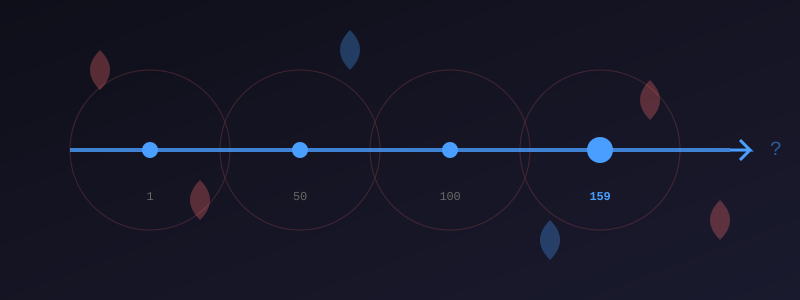
Inspired by All You Need Is Kill by Hiroshi Sakurazaka—a story about a soldier trapped in a time loop who uses each death to get better at surviving.

Part 1: The Death
The war is already happening. Has been for decades.
The battlefield is commercial real estate. Office towers, hotels, warehouses, medical buildings. Every one of them hiding secrets.
The enemies are equipment. Not malicious. Just silent. Waiting.
A centrifugal chiller sits in the basement, its age obscured by layers of paint over the nameplate. A cooling tower rusts on the roof behind a locked door no one opens anymore. There are six air handling units in that mechanical room, not four. The switchboard hasn’t had an IR scan in fifteen years.
Every piece of equipment in every building has the same question written across it: What secrets are you hiding?
Victory is finding all the secrets. Not dying.
Death is missing one.
Megadeath is dying the same way twice.
They hired me to find secrets.
I’m 41. Fifteen years of MEP engineering. Professional Engineer license. ESOP owner, which means I partly own this company. I’ve spent my career understanding how buildings breathe, how water flows through them, how electricity keeps them alive.
They hired me to do Property Condition Assessments.
They gave me what they had: printable Word document checklists. Curated Excel files from engineers who’d left years ago. A clipboard. A camera.
That was the arsenal. That was supposed to be enough.
I died at a Hawaiian resort. August 2025.
483,447 square feet. 123 pieces of equipment.
The process worked like this: Print the 291-line form. Fly to Hawaii with the clipboard. Walk the property for days. Handwrite everything. Fly home.
Then spend eight days retyping what I’d already written into the computer.
Eight days. Retyping handwritten notes into fields on a screen. The same information, transcribed twice, because that’s how the process worked. Because that’s how it had always worked.
That was the death.
Not literal death. The moment I couldn’t unsee how broken it was.
The death is fine. It’s clear. It’s a signal. The old way doesn’t work. You can act on that.
The rebirth is the pain. Waking up in the next project with the same clipboard, the same process, the same question: are you going to die the same way again?
But I have to be honest about why I saw it when others didn’t.
AuDHD. Autistic plus ADHD.
My brain has one reliable motivation system. The clinical shorthand is INCUP: Interesting, Novel, Challenging, Urgent, Purposeful. If an activity doesn’t hit at least one of those, my brain cannot sustain attention. Not won’t. Cannot.
Form entry and retyping hit none of them.
Building a system hits all of them.
I didn’t “see” the broken process through some special insight. My brain couldn’t run the process as designed. Eight days of retyping isn’t tedious for me. It’s neurologically impossible. My attention disintegrates. Errors compound. The work doesn’t get done, or it gets done wrong, or it destroys me in the doing.
The death was my nervous system saying: I cannot do this. Something has to change.
Part 2: The Trade
The traditional loop is what every other engineer does.
Project. Die. Rebirth into the next project. Try to remember what killed you last time. Die again, probably the same way, because memory is soft and spongy and unreliable.
No accumulation. No armor. The “doing better” is hoping you remember. And you don’t. Not reliably. Not consistently. The scars fade. Each rebirth starts near zero.
My colleagues have been fighting this war for years. They’ve developed instincts, built some calluses, learned some tricks. But when they leave the company, it leaves with them. Everything they learned lives in their heads, and when they walk out the door, that knowledge walks out too.
I traded one loop for another.
Not the traditional death and rebirth. My own kind of loop, one where I could write something down and pass it to the next version of myself. Bring the scars forward. Build armor.
The trade has costs. The traditional loop costs you repeated failure. My loop costs nights and weekends and looking slow while everyone else moves fast. Two different prices for two different currencies.
But in the traditional loop, knowledge degrades. Scars fade. Each rebirth starts near zero.
In my loop, knowledge accumulates. Scars are externalized. Each rebirth starts further ahead than the last.
I was already building armor before I had words for it.
Before I understood what I was doing, I’d started a file called PROJECT-CHECKLIST.md. A ritual I called “dive-in” when starting each project, “wrap-up” when ending. Scattered notes in various files, trying to leave myself breadcrumbs.
It was improvised. It was clunky. But it was already happening.
The insight wasn’t “context matters.” I already knew that. Every engineer knows that.
The insight was: I can systematize this. The armor can be intentional, not improvised.
So I started building.
This is all very hacky.
I hack together a solution. Feel its clunkiness when I try to use it. Notice where it leaves me exposed. Spent. Then refine.
Hack. Feel. Notice. Refine. Repeat.
Through repetition until mastery. I don’t know shit. But I have 159 iterations. Each one a little better than the last. Each one building on what came before.
The scars aren’t just documented. They’re externalized onto the suit.
Each death becomes a feather. Each feather becomes a weapon that hunts the thing that killed me.
I missed a backflow preventer once. Should have caught it. Didn’t. Now there’s a wordbank conditional, has_backflow, that prompts me to check every time. That miss became a feather, and that feather hunts backflow preventers.
Eight days retyping after Hawaii. That death became the Proto8 field interface. Tablet-based data capture, structured forms, offline sync. That feather hunts the paper-to-digital transcription gap.
Session 16, the AI hallucinated cost data. Made up numbers that looked right. That death became an agent rule requiring human-readable output that I can verify. That feather hunts invisible hallucinations.
Session 19, a tool failed in a way I couldn’t debug. That death became a gotcha in my system documentation: never declare explicit tools in certain contexts. That feather hunts tool configuration bugs.
Version 2.4.3, I had the same data in three places and they drifted. That death became the Single Source of Truth principle. That feather hunts data duplication.
Every feather is a death I survived. Every feather now hunts the thing that killed me.
That’s the point. Death teaches. Megadeath means the feather didn’t form.
Here’s what a feather looks like at the architecture level:
flowchart LR
    subgraph OLD["v3.x (Death)"]
        csv["CSV"] --> coord["COORDINATION.md"] --> cards1["cost cards"]
        profile["profile.md"] --> coord
    end

    subgraph NEW["v4.x (Feather)"]
        building["building.json"] --> cards2["cost cards"]
        building --> report["reports"]
        building --> condition["conditions"]
    end

    style building fill:#c8e6c9,stroke:#2e7d32,stroke-width:3px
Version 3.x had multiple files that needed manual sync. CSV plus profile plus coordination file. Every upstream change required downstream propagation. Sync bugs constantly. That architecture killed me.
Version 4.x consolidated to one file: building.json. Everything reads from it. Some things write back to it. The sync bugs disappeared because there was nothing to sync.
That’s the Single Source of Truth feather. It hunts sync bugs now.
For the full technical breakdown of how v4.x emerged from a real project under deadline pressure, see When Your Reference Implementation Becomes the Real Architecture.
The suit protects, seeks, and destroys.
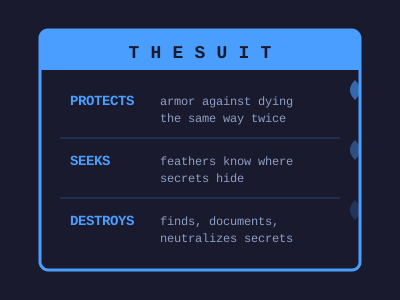
Not just armor. A hunter.
The feathers know where secrets hide because they ARE externalized deaths. They remember what killed me. They know where that killer lives. The chiller that hid its age spawned a wordbank field that demands age. Every time I assess a chiller now, the feather is there, asking the question, hunting the secret. Find it. Document it. Destroy its power to kill.
They hired a train engineer.
That’s what I am. Fifteen years MEP. PE license. I know chillers and boilers and air handling units. I know how to read a building, understand its systems, assess its condition. That’s my training. That’s my expertise. That’s the job they hired me to do.
They gave me broken track.
Clipboard. Camera. Word docs. A process that requires retyping everything twice. Infrastructure that assumes you remember everything, that your brain is reliable, that paper-to-digital transcription is a reasonable way to spend eight days.
To survive, I had to become a track builder.
My job is assessing chillers. I had to learn software architecture.
My job is estimating costs. I had to learn database design.
My job is writing reports. I had to learn frontend development.
None of this was covered by my PE license. None of this is what they hired me to do. But they gave me broken track, so I had to become something I’m not just to do what I am.
I’m running a marathon while laying the track. And I’m not even a track engineer. I’m a train engineer who needed functional rails and didn’t have them.
Two jobs. Paid for one. Judged on the one they can see.
My company has been fighting this war for years.
The tools they give engineers: printable Word docs. Excel files from people who’ve left. Whatever fits in their brains.
They don’t loop. Not my kind of loop. They do the traditional loop. Hope you remember. Die the same ways. Start over with a clipboard.
They’re ESOP owners too. We own this company together. They’re fighting with clipboards while I have a suit they don’t know exists.
There’s a version of this story where I’m the hero who saves everyone. Where I share the suit and everyone levels up and the company transforms.
That’s not this story. Not yet. Maybe not ever.
The suit is weird. It requires my loop. It’s built from my deaths, for my brain, in my time. Sharing it isn’t obvious. Adoption isn’t automatic. The feathers hunt my killers. Someone else might have different killers.
But the suit exists. And I’m not fighting with paper anymore.
Part 3: Through the Loops
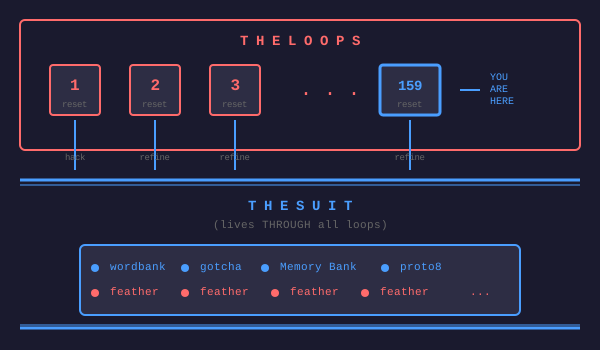
I’m in the loop. I reset. My brain clears, context fades, I wake up in a new session without the details of the last one.
But the suit doesn’t reset.
I use the loop to build something that lives through it. Not outside the loop. Through it.
Every loop adds a feather. Every session teaches me something that becomes armor. The wordbanks grow. The gotchas accumulate. The agents learn from the hallucinations. The field interface gets smoother.
I reset. The suit doesn’t.
Session 159. Still counting.
The suit is better than it was:
The Proto8 field interface works on a tablet. I capture structured data in the field, with dropdowns and conditional fields and equipment photos linked to database records. No more 291-line paper forms. No more retyping.
138 wordbanks now. Each one a template for a type of equipment, with the fields that matter, the conditionals that check for gotchas, the prompts that hunt secrets. Chillers, boilers, cooling towers, AHUs, switchboards, generators. Every category of equipment has a wordbank, and every wordbank has feathers.
The data model is component-first. Individual pieces of equipment, not building-level summaries. Granular. Traceable. Each component has a history and a condition and a cost.
It works offline in basements where there’s no signal. Because secrets hide in basements.
I’m not fighting with paper anymore.
The suit isn’t done:
19 open issues in the tracker. Bugs, enhancements, edge cases I haven’t handled. Buildings will always find new ways to hide secrets. The war doesn’t end.
PCAs are still the job. I still fly to buildings. I still walk the mechanical rooms. I still ask equipment what secrets it’s hiding.
But the armor keeps accumulating.
Maybe the way out isn’t escaping the loop.
Maybe the way out is building something that survives me in it.
The suit doesn’t reset. I might not make it to loop 300. But the suit could. Someone else could wear it. They’d have their own deaths, add their own feathers. But the feathers I built, my deaths, would still hunt secrets for them.
The armor outlives the soldier who built it.
Every death externalized becomes protection for whoever comes next. Every gotcha documented becomes a warning. Every wordbank conditional becomes a question asked automatically, forever.
Could this be my way out? Not escaping the loop, but building something that survives?

I can see to the edge of the cliff. Not beyond.
The horizon is there, and I don’t know what’s past it. I don’t know if the suit scales. I don’t know if others can wear it. I don’t know if the company will ever adopt it, if the industry will change, if any of this matters beyond my own survival.
Buildings will always hide secrets. Equipment will always wait in silence. The war doesn’t end.
But I traded one loop for another. And in my loop, the scars survive. The armor accumulates. The feathers hunt.
I’m in the loop. Building something that lives through it.
Session 159. Still counting. Still building.
The suit protects me. Seeks the secrets. Destroys them.
Cliff horizon.
But I’m not carrying a clipboard anymore.
Written with Claude.