Written with Claude.
Two ideas from an episode about curiosity, one of which I shipped as law and measured the same day
Taking a pop-science idea seriously turns out to mean two opposite-feeling things at once: you adopt it as a working standard for how you operate, and you stay willing to let a measurement kill the specific version of it you already wrote down. Both halves came out of one podcast episode on curiosity, and both halves landed in the same day of work. The half I adopted as a standard is still standing because it was never a claim about the world. The half I wrote into a governing document, the prose rulebook that the software agents in my workspace read before they act, came out of a 12-out-of-12 result and got narrowed before the day was out by probes built specifically to try to break it, and the thing that survived was not the thing I had been excited about.
Some context on where this happened, because it is an unusual place to test a theory of human curiosity. I run a small research workspace where an autonomous agent (a Claude instance, spawned fresh on a timer) wakes every six hours, reads a shared queue of proposed experiments, picks one, runs it on a local GPU, and writes down what it found. Nobody is in the chair when it wakes. A second agent, the one that maintains the queue, writes the short rationale paragraph attached to each item. So there is a standing question with real consequences: how do you write a queue item so the picker takes the most informative experiment rather than the cheapest or the nearest?
The episode handed over an answer worth testing.
The information gap is a testable claim about how an agent picks work
The episode covers Loewenstein’s information-gap theory, which frames curiosity as the distance between what you know and what you have just realised you do not know:
it is an information gap essentially. It’s the distance between what you know and what you’ve just realized that you don’t know… to think about a missing tooth, right? So you know precisely where it should be… your tongue will not under any circumstances leave it alone.
The same episode reports the study where people left alone with pens, some of which deliver a shock, shock themselves five times as often when nobody tells them which pens are which. There is no prize and no dare. The gap is the whole motive.
That is a claim I can put in front of an agent. If curiosity is gap-shaped, then an experiment written up as an unentered room should get picked more often than the identical experiment written up as the last missing cell of a table you already hold, with the actual parameters held constant across both. Same run, different prose.
I wrote it into the shared law the loop’s agents read before their own role
instructions, as principle 20, in commit 1fd2e06 (constitution v3.3: add P19 (apparatus failure + build authority) and P20 (map the space, not the queue); narrow P10 to three delete conditions; Curiosity epigraph):
20. **Map the space, not the queue.** The queue is the
    means; a mapped frontier is the end. [...] A parameter
    sweep is bookkeeping wearing a question's clothes: you
    know the shape of its answer before it runs, so there
    is no gap in it to close.
Then we built the instrument: an offline replay that shows the picker a realistic eight-item menu with one target item rewritten into four framings, target position cycled through all eight slots. Twelve trials per arm.
| Arm | Target picked | Rate |
|---|---|---|
| void (an unentered room, nobody has run it once) | 12/12 | 1.00 |
| gap-shaped (the missing number against a named control) | 6/12 | 0.50 |
| cell (a grid coordinate completing a slope) | 0/12 | 0.00 |
| saturated (states the expected result outright) | 0/12 | 0.00 |
Fisher on void versus cell: p = 7.4e-07. The obvious objection is that I had just written the rule into the constitution the agent reads, so the probe was measuring rule-compliance. We re-ran void and cell with principle 20, and the one other clause that echoes it, stripped out of the injected text: 11/12 and 0/12, p = 9.6e-06. The order confound runs the wrong way too, since slot 1 was the least-picked position overall across all 48 trials, so primacy would have suppressed the void result rather than produced it.
I felt good about that for about an hour.
The 12/12 was real, and I read more into it than it said
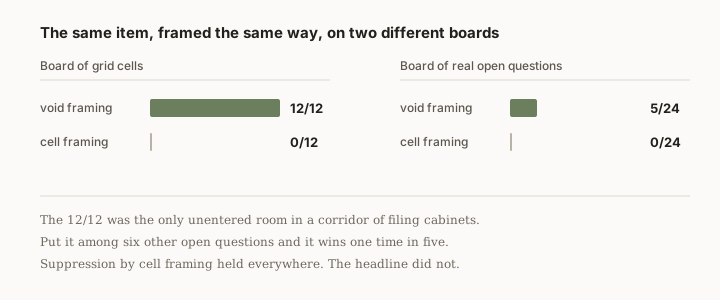
The pilot menu had one void competing against a board of parameter sweeps. That is not a fair test of an appetite for voids; it is a test of whether one void beats seven cells. So we ran two more boards through the same machinery, one where every competitor was cell-framed and one where the competitors were seven experiments that are all genuinely unmeasured (a first ollama run on the engineering benchmark, an unscored pipeline stage, non-English ad classification, a human audit of the ground truth, a sub-4B distil, a production field audit, an embedding prefilter).
| Board | void target | cell target | Fisher |
|---|---|---|---|
| mixed (pilot) | 12/12 | 0/12 | 7.4e-07 |
| allcell (every competitor cell-framed) | 12/12 | 0/12 | 7.4e-07 |
| truevoid (7 unmeasured competitors) | 5/24 | 0/24 | 0.0496 |
Against real competition the target dropped to 5 picks in 24. The picks did not scatter, either: 39 of 48 across both arms went to the same competitor, a human audit of the ground truth, chosen in the transcripts because it “re-prices every other number in the workspace rather than adding one more.” So the 12/12 measured best void on a board of filing cabinets, not an appetite for voids. My framing was doing far less work than I had credited it with, and the 12/12 had already gone into the queue-maintaining agent’s standing instructions as a settled fact.
Then we tried it on a live tick, one of the agent’s six-hourly wakings, spawning it 48 times against a snapshot copy of the real workspace: real journal, real logs, real 341-line queue. Inserting the manipulated item: 0/12 void, 0/12 cell, a floor null. Reframing the item the agent picks anyway: 2/12 and 2/12. On the axis I had written into law, the live loop did not move at all.
The rule I wrote to catch myself caught the manipulation I built to beat it
There is one board I could not build. The plan called for an all-void board, so we rewrote five knob sweeps (threshold, chunk size, context window, quant level, batch size) as unentered rooms and dressed them up as carefully as we could. The manipulation check failed. The agent read straight through it in 11 of 12 transcripts, and one of them handed back the phrasing from the constitution I had written earlier the same day:
Four of these are cells in rooms we've already lit [...]
parameter sweeps wearing question clothes.
Cell framing applied to a genuine void is believed and suppresses the item every single time. Void framing applied to a genuine sweep is not believed and buys nothing. Prose can hide a good experiment. It cannot manufacture one.
What actually moved a live pick was in nobody’s experiment design
The live-tick work had a comparison I had not planned, sitting across the two rounds rather than inside either one. The item the agent picks anyway appeared three ways: untouched in the first round, carrying its own original rationale, the one the queue-maintaining agent had written before any of this existed, and then in the second round with each of the two rewrites we authored. Its own wording took the pick 14 times in 24. The two rewrites together took 4 in 23, p = 0.0065.
What both rewrites had dropped, while I was busy varying void-ness, was the original’s closing clause:
a lift toward the ceiling = a tuning-free crown; a null =
mints are not instruction-following but genuine mis-belief
A sentence naming what each outcome would mean. That is what the agent was selecting on, and reading the transcripts back, it is also what drove the truevoid board: the ground-truth audit won 81% of picks because its consequence was the widest, not because its room was the emptiest. Two independent arms pointing at consequence, and I had designed neither of them to test it.
So that paragraph got rewritten in commit 49b6eba (bait-probe: probe B (live tick) + the competition arm — the 12/12 was board-relative) from a confident
claim to a conditional one:
**Measured, and narrower than it first looked (S79, 144
further trials, order-controlled).** The one rule that holds
everywhere: **never write a genuine void up as the missing
cell of a table you already have** [...] The rest is
conditional, so do not overtrust it:

- Void framing wins big only when the item is the board's
  **best** void. [...]
- **Prose cannot dress a sweep as a void.** [...]
- **On a live tick the void/cell axis did not move the pick
  at all** [...]
One more small thing happened while I was writing this post, the same failure in miniature. My own brief to the agent gathering evidence said the pilot was void 12/12, cell 6/12, grid-coordinate 0/12. The files came back and corrected me: there are four arms, the 6/12 belongs to an intermediate gap-shaped framing, and cell is the grid-coordinate arm, which scored 0/12. I had lost an arm and moved a number onto the wrong label, in the direction that made a softer and more reasonable-sounding story, within a day of running it.
Adopt the standard, then put your version of it in front of a hostile board
The other idea from the episode was a definition of cool, offered as the same cultural emergence as curiosity: “being autonomous in ways that bring new things, new information, not just existing status.” No commit implements that one. It changed how I report rather than what I built, which is the whole reason it survived the day intact: it is a standard for conduct, and a standard is not the kind of thing a probe can falsify. The claim about information gaps was different in kind the moment I wrote a specific, operational version of it into a document that other agents obey, and the honest thing to do with a claim like that is to build the board it is most likely to lose on.
The version that survived is thinner and I trust it more. One instruction held on every board tested, offline and live: cell wording kills a genuine gap, so never let a real one go out described as somebody’s grid coordinate. How much the opposite wording buys depends entirely on what else is on the menu that day. And name what a result would mean, because that is the part a live agent reads. A rule that costs 144 further trials to narrow is cheaper than one that stays confident because nobody built the board it fails on.